Introduction
Artificial Intelligence is transforming industries at an unprecedented pace, driving innovation across healthcare, finance, manufacturing, education, research, and government sectors. As AI adoption grows, so does the demand for computing power, data storage, networking capabilities, and advanced infrastructure.
However, supporting AI at scale comes with significant energy and resource requirements. Modern AI workloads consume vast amounts of power and generate substantial heat, making sustainability a critical consideration for the future of digital infrastructure.
Building sustainable AI infrastructure is no longer just an environmental objective – it is a strategic necessity. Organizations, governments, and infrastructure developers are increasingly focused on creating AI ecosystems that balance performance, scalability, and environmental responsibility.
Why It Matters
The rapid expansion of AI has increased demand for:
- High-density GPU computing
- Large-scale data centers
- Advanced cooling technologies
- Reliable power infrastructure
- High-speed networking systems
These requirements can lead to increased energy consumption if not managed efficiently.
Sustainable AI infrastructure addresses these challenges by focusing on:
- Energy efficiency
- Renewable energy integration
- Optimized cooling systems
- Responsible resource utilization
- Long-term environmental sustainability
As AI continues to become a core component of business operations and economic growth, sustainable infrastructure will play a vital role in ensuring that technological progress remains both scalable and environmentally responsible.
Key Opportunities
1. Renewable Energy Integration
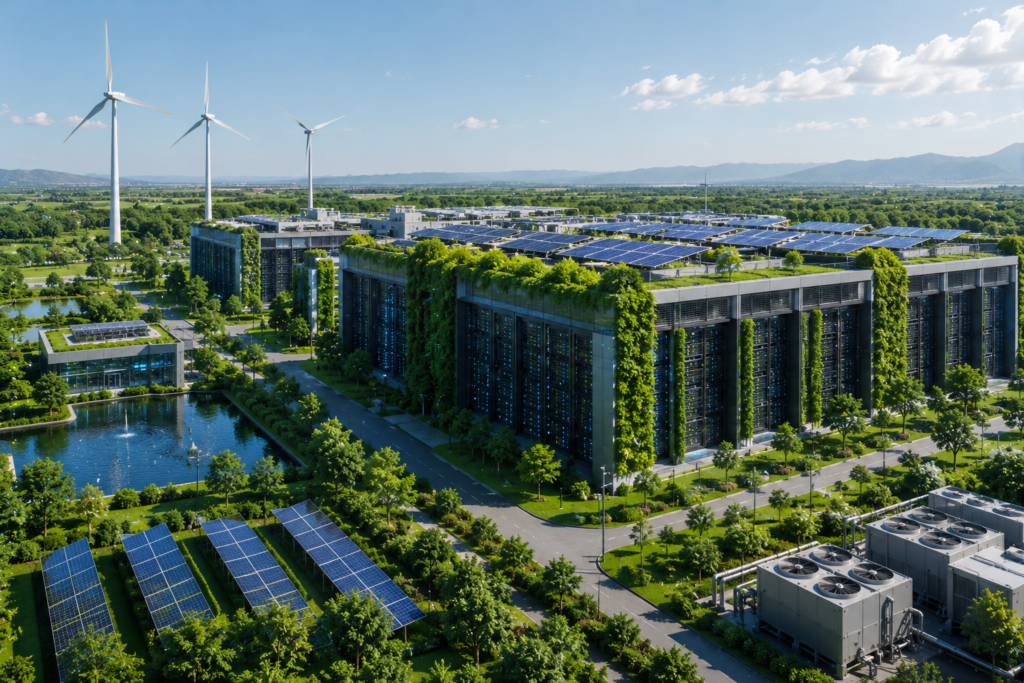
The adoption of solar, wind, and other renewable energy sources enables AI infrastructure operators to reduce dependence on traditional energy systems while supporting sustainability goals.
2. Energy-Efficient Data Centers
Modern AI facilities are increasingly designed to optimize power consumption through advanced technologies, intelligent monitoring systems, and efficient infrastructure management.
3. Advanced Cooling Solutions
Innovations such as liquid cooling and next-generation thermal management systems help reduce energy usage while supporting high-density AI workloads.
4. Sustainable Infrastructure Development
Large-scale AI campuses can incorporate environmentally responsible design principles, improving long-term operational efficiency and reducing environmental impact.
5. Growing Investor Interest
Sustainable infrastructure projects are attracting significant attention from investors seeking opportunities aligned with environmental, social, and governance (ESG) objectives.
Business Impact
Sustainable AI infrastructure delivers benefits that extend beyond environmental performance.
Reduced Operating Costs
Energy-efficient systems can help lower power consumption and improve long-term cost management.
Enhanced Infrastructure Reliability
Modern sustainable facilities often incorporate advanced monitoring and optimization technologies that improve operational performance.
Improved Corporate Sustainability Goals
Organizations can align AI growth initiatives with broader environmental commitments and sustainability strategies.
Greater Investor Confidence
Sustainability-focused infrastructure projects may attract strategic partnerships and long-term investment opportunities.
Long-Term Scalability
Efficient infrastructure designs enable organizations to support growing AI workloads without proportional increases in resource consumption.
Future Outlook
The future of AI infrastructure will increasingly be shaped by sustainability considerations.
Key trends expected to influence the next generation of AI facilities include:
- Renewable-powered AI campuses
- Gigawatt-scale sustainable infrastructure developments
- Advanced liquid cooling technologies
- Smart energy management systems
- Carbon-conscious infrastructure design
- Circular economy practices in technology operations
- Increased adoption of green building standards
As AI workloads continue to expand, sustainability will become a critical factor in determining how infrastructure is designed, operated, and scaled.
Organizations that prioritize sustainable infrastructure today will be better positioned to meet future regulatory, environmental, and operational requirements.
Conclusion
Artificial Intelligence has the potential to drive extraordinary innovation and economic growth. However, realizing this potential requires infrastructure that is not only powerful and scalable but also sustainable.
Building sustainable AI infrastructure means integrating renewable energy, improving energy efficiency, optimizing cooling systems, and adopting environmentally responsible operational practices.
As the demand for AI continues to rise, the industry must focus on creating infrastructure ecosystems that support technological advancement while minimizing environmental impact.
The future of AI will depend not only on the intelligence of machines but also on the sustainability of the infrastructure that powers them. By investing in sustainable AI infrastructure today, organizations can help build a smarter, greener, and more resilient digital future.