Introduction
Artificial Intelligence (AI) is rapidly transforming industries across the globe, and India is emerging as one of the world’s fastest-growing AI markets. From healthcare and finance to manufacturing, agriculture, education, and government services, AI is becoming a key driver of innovation and economic growth.
However, AI’s success depends on more than algorithms and software. Behind every AI model, machine learning application, and large language model lies a powerful infrastructure ecosystem capable of supporting massive computing requirements. As India accelerates its AI ambitions, the need for advanced AI-ready infrastructure has never been greater.
Why It Matters
Traditional IT infrastructure was designed for conventional business applications, cloud services, and enterprise workloads. AI workloads are fundamentally different.
Modern AI training and inference require:
- High-density GPU computing environments
- Massive power availability
- Advanced cooling systems
- Ultra-low latency networking
- Scalable storage architectures
- High-speed data transfer capabilities
Without dedicated AI infrastructure, organizations face challenges such as slower model training, increased operational costs, reduced performance, and limited scalability.
As India positions itself as a global technology powerhouse, building robust AI infrastructure becomes a strategic necessity rather than an optional investment.
Key Opportunities
1. Growing Enterprise AI Adoption
Indian enterprises are increasingly deploying AI solutions for automation, analytics, customer experience, fraud detection, and operational efficiency. This creates growing demand for AI-ready computing environments.
2. Government-Led AI Initiatives
National and state-level AI programs are encouraging innovation across sectors including healthcare, agriculture, education, public services, and smart cities. These initiatives require large-scale computing resources and secure infrastructure.
3. Expansion of AI Startups
India has one of the world’s largest startup ecosystems. Thousands of AI-focused startups are developing solutions that require access to scalable GPU infrastructure for model development and deployment.
4. Global AI Investments
International technology companies are seeking strategic locations for AI infrastructure deployment. India offers a large talent pool, growing digital economy, and supportive policy environment.
5. Demand for Sovereign AI Infrastructure
Organizations increasingly prefer hosting critical AI workloads within national borders to ensure compliance, security, and data sovereignty requirements.
Business Impact
Investing in AI-ready infrastructure delivers significant advantages for organizations:
Faster Innovation
High-performance GPU infrastructure enables faster model training and experimentation, reducing development cycles and accelerating time-to-market.
Improved Operational Efficiency
AI-powered automation can streamline workflows, reduce manual processes, and improve productivity across departments.
Enhanced Competitive Advantage
Organizations with access to scalable AI infrastructure can deploy advanced AI applications faster than competitors.
Better Scalability
Dedicated AI facilities provide the flexibility to scale computing resources as workloads grow, avoiding infrastructure bottlenecks.
Long-Term Cost Optimization
Purpose-built AI infrastructure can improve energy efficiency, resource utilization, and operational performance, reducing overall ownership costs.
Future Outlook
India’s AI economy is expected to witness substantial growth over the next decade. Emerging technologies such as Generative AI, Autonomous Systems, Digital Twins, Advanced Analytics, and AI-driven Research will significantly increase demand for computing power.
Future AI infrastructure developments will likely include:
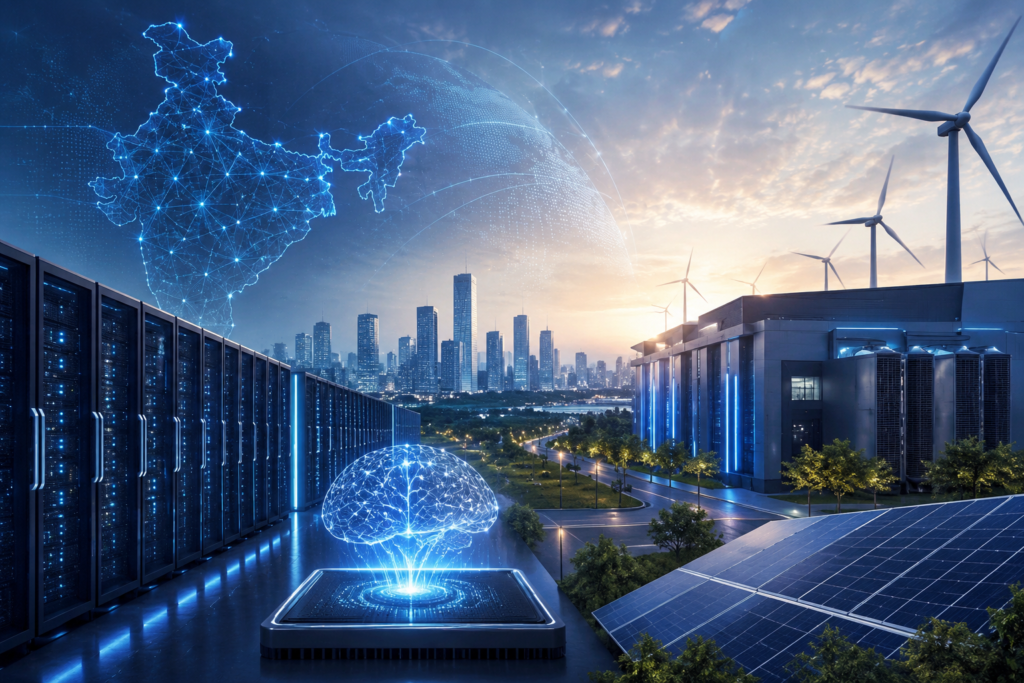
- Gigawatt-scale AI campuses
- Large GPU clusters
- Renewable energy integration
- Advanced liquid cooling technologies
- Edge AI infrastructure
- High-speed interconnect ecosystems
- Sustainable hyperscale AI facilities
Organizations that prepare today will be better positioned to capitalize on future AI opportunities.
Conclusion
India’s AI revolution is no longer a future possibility—it is already underway. As AI adoption expands across industries, infrastructure becomes the foundation that enables innovation, scalability, and long-term growth.
The next phase of India’s digital transformation will depend on the availability of reliable, scalable, and sustainable AI infrastructure capable of supporting the nation’s growing computational needs. Investments in AI-ready data centers, GPU infrastructure, power systems, and advanced connectivity will play a critical role in shaping India’s position in the global AI economy.
The future of AI is not built solely on software – it is powered by infrastructure.