Introduction
Artificial Intelligence is transforming industries, accelerating innovation, and redefining the future of computing. From Generative AI and Large Language Models (LLMs) to machine learning and high-performance computing, modern AI applications require unprecedented levels of computational power.
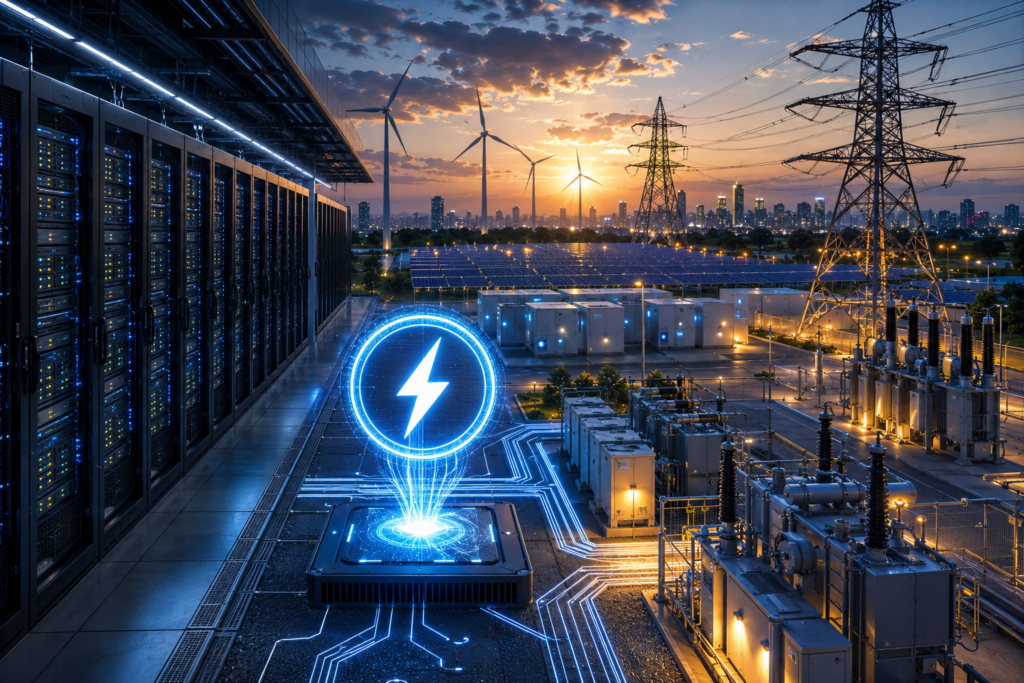
Behind every AI model, data center, GPU cluster, and intelligent application lies one critical resource that makes it all possible – power.
While discussions around AI often focus on algorithms, data, and technology, the reality is that none of these innovations can operate without a reliable and scalable power infrastructure. As AI adoption continues to grow, access to power is becoming one of the most important factors influencing the success of AI ecosystems worldwide.
Why It Matters
AI workloads consume significantly more energy than traditional computing applications.
- Training advanced AI models requires:
- Thousands of high-performance GPUs
- Continuous computational processing
- Large-scale storage systems
- Advanced cooling technologies
- High-speed networking infrastructure
All of these systems depend on a stable and uninterrupted power supply.
As AI models become larger and more sophisticated, power demand continues to increase. Organizations building AI infrastructure must ensure they have access to sufficient energy resources to support both current and future workloads.
Without adequate power availability, AI growth can be constrained by infrastructure limitations rather than technological capabilities.
Key Opportunities
1. Enabling Large-Scale AI Deployments
Reliable power infrastructure allows organizations to deploy large GPU clusters capable of supporting advanced AI training and inference workloads.
2. Supporting Hyperscale AI Campuses
Gigawatt-scale AI campuses require substantial energy resources. Access to large power capacities enables the development of future-ready AI ecosystems.
3. Accelerating Digital Transformation
Organizations with access to robust power infrastructure can adopt AI technologies faster and scale operations more efficiently.
4. Renewable Energy Integration
The growing availability of solar, wind, and other renewable energy sources creates opportunities for sustainable AI infrastructure development.
5. Attracting Technology Investments
Regions with strong power infrastructure are becoming preferred destinations for hyperscalers, cloud providers, and AI-focused enterprises seeking long-term growth opportunities.
Business Impact
Power infrastructure plays a direct role in determining the success of AI operations and digital ecosystems.
Operational Reliability
Consistent power availability ensures uninterrupted AI workloads, reducing downtime and maintaining performance.
Improved Scalability
Organizations can expand computing resources and deploy larger AI environments when sufficient power capacity is available.
Faster Innovation
Reliable infrastructure enables businesses to accelerate AI model development, experimentation, and deployment.
Cost Efficiency
Well-planned power systems help optimize operational costs, improve energy utilization, and support sustainable growth.
Competitive Advantage
Access to scalable power infrastructure allows organizations to deploy AI technologies more effectively and respond quickly to market opportunities.
Future Outlook
As global AI adoption continues to expand, power demand is expected to grow substantially.
Several trends will shape the future of AI power infrastructure:
- Development of gigawatt-scale AI campuses
- Expansion of renewable energy integration
- Advanced energy management systems
- High-efficiency power distribution networks
- Sustainable AI infrastructure ecosystems
- Grid modernization initiatives
- Increased focus on energy security and resilience
Future AI facilities will require infrastructure designed not only for today’s workloads but also for the next generation of computational demands.
Power availability will increasingly become a strategic factor influencing where AI infrastructure is built and how effectively organizations can scale their operations.
Conclusion
Artificial Intelligence is often described as the technology of the future, but its success depends on a foundation that is far less visible – power.
From training complex AI models to supporting hyperscale GPU clusters, every aspect of AI infrastructure relies on reliable, scalable, and sustainable energy resources.
As AI continues to reshape industries and economies, power infrastructure will play an increasingly important role in enabling innovation, supporting digital transformation, and driving long-term growth.
The future of AI is not powered by algorithms alone – it is powered by the infrastructure and energy systems that make advanced computing possible.
For organizations, investors, and infrastructure developers, understanding the critical relationship between power and AI will be essential for building the next generation of intelligent technologies.